Tuesday, 5 December 2017

10 Apples up on Top

Can you design and build the tallest apple tower? How will your apple balance up on top?

Another library design challenge for Prep (Foundation) students. After reading Dr. Seuss' 'Ten Apples up on Top', students worked in small teams to design and build the tallest apple tower. Their apple needed to balance on the top of their tower and they were not allowed to hold it during the 'testing' phase. We measured each tower using unifix cubes.

They were so engaged and it was great to hear their collaborative discussions:
"What if we use plasticine to make it more stable?"
"Oh yeah... that is a good idea. Also, we could put the plasticine on the top to sit the apple on."
"Would that be balancing though?"
"There wasn't a rule about that!"

So much fun with these little engineers!


Tuesday, 28 November 2017

Tuesday, 7 November 2017

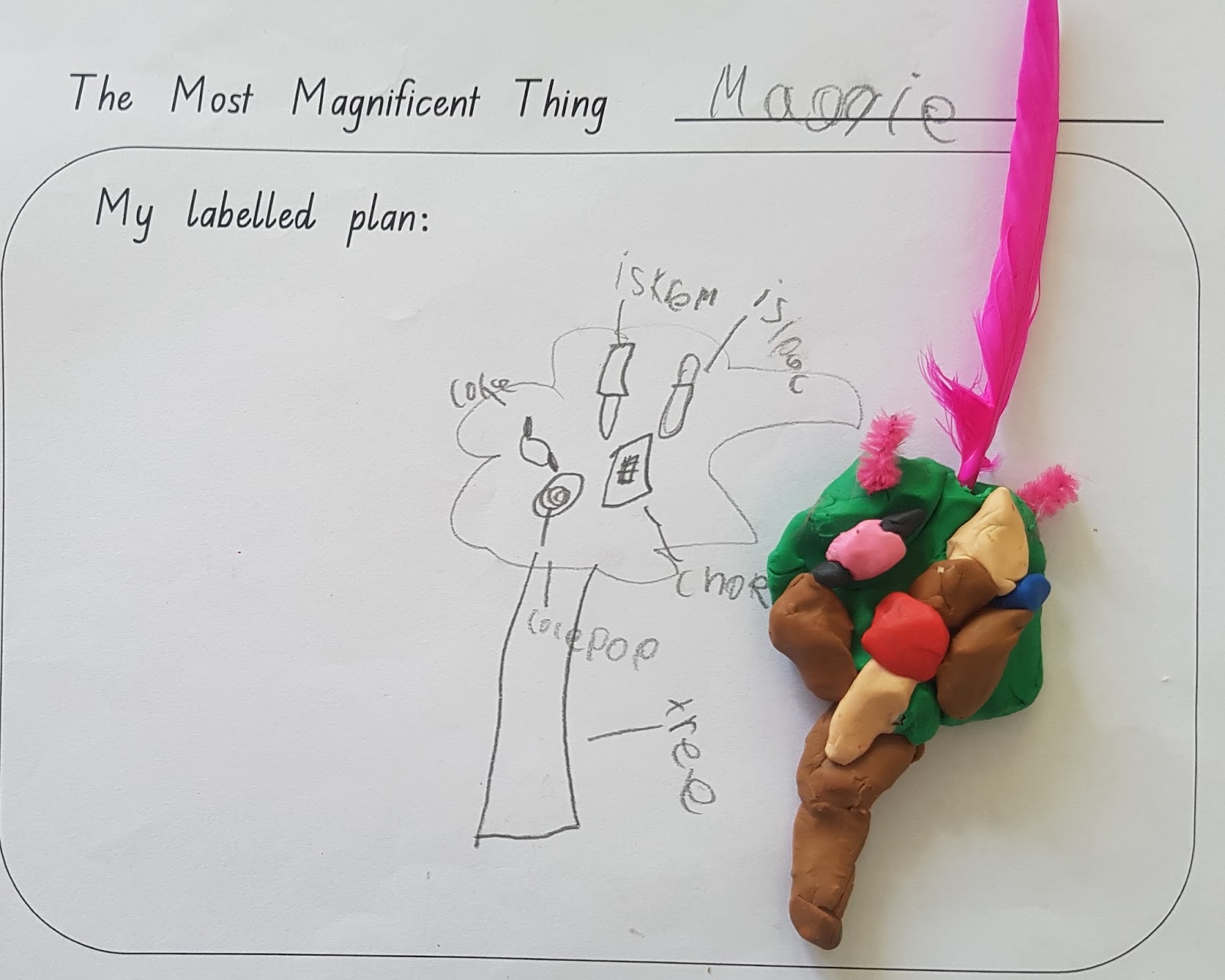
The Most Magnificent Thing

My Prep (Foundation) students loved this STEM themed library lesson! 

Lesson outcomes
·         Record ideas with a labelled drawing
·         Make a model using different materials
·        Share ideas and creations with others

Lesson Steps

1. Read The Most Magnificent Thing by Ashley Spiers

2. Present Open Ended Challenge – to design and build your most magnificent thing.  If you could make or create anything, what would it be? What could it be used for?

3.  Discuss learning intentions: “We are learning to…”

4. Provide opportunity for students to explore materials available to them.  Brainstorm during whole group the kinds of things they might create.

5. Sketch and label a plan of their ‘most magnificent thing’ as well as a list or drawings of the materials they will need.

6. Choose from a variety of supplied materials to create and build their model.

7. Share their most magnificent things and reflect on learning. 


They were all so proud of their magnificent things!


“When we allow children to experiment, take risks, and play with their own ideas, we give them permission to trust themselves. They begin to see themselves as learners who have good ideas and can transform their own ideas into reality” (Martinez & Stager, 2013, p. 36). 

Australian Curriculum Links:
Design and Technologies: Foundation – Year 2: Generate, develop and record design ideas through describing, drawing and modelling (ACTDEP006)
Arts – Visual Arts: Foundation – Year 2: Create and display artworks to communicate ideas to an audience (ACAVAM108)
General Capabilities - Critical and Creative Thinking: Imagine possibilities and connect ideas

Monday, 30 October 2017

Egg Car Challenge

Can we design a vehicle which will keep a passenger (egg) safe under normal driving conditions and in the event of a crash?


We are learning to:
· Solve problems using engineering design process
· Explain how forces and the properties of materials affect the behaviour of an object
· Create a simple budget and solve problems involving financial purchases

Design Brief: 
Follow the Engineering Design Process to design and create a vehicle.  The vehicle must transport cargo down a ramp in the fastest and safest way possible.  You will need to plan the best way to overcome friction and maintain enough speed to make it down the ramp. In addition, the vehicle will have to be stable enough to transport the precious cargo (egg) without damaging it.  Can you build a safe vehicle? How will you get the vehicle to slide or roll down the ramp?  Will the cargo arrive safely?  What will happen if the angle of the ramp is changed?  You will also need to stay within a budget and must “purchase” materials to use.


An unfortunate mishap

Australian Curriculum Links
General Capabilities: Critical and Creative Thinking – Generating ideas, possibilities and actions; Reflecting on thinking and processes

Science
Year 3:
· Consider the elements of fair tests and use formal measurements and digital technologies as appropriate, to make and record observations accurately (ACSIS055)
· Reflect on investigations, including whether a test was fair or not (ACSIS058)
Year 4:
· Consider the elements of fair tests and use formal measurements and digital technologies as appropriate, to make and record observations accurately (ACSIS066)
· Forces can be exerted by one object on another through direct contact or from a distance (ACSSU076)
Year 5:
· Compare data with predictions and use as evidence in developing explanations (ACSIS218)

Maths
Year 3:
·     Represent money values in multiple ways and count the change required for simple transactions to the nearest five cents (ACMNA059)
·     Measure, order and compare objects using familiar metric units of length, mass and capacity (ACMMG061)
Year 4:
·Solve problems involving purchases and the calculation of change to the nearest five cents with and without digital technologies (ACMNA080)
· Use scaled instruments to measure and compare lengths, masses, capacities and temperatures (ACMMG084)
Year 5:
· Create simple financial plans (including simple budget) (ACMNA106)
· Choose appropriate units of measurement for length, area, volume, capacity and mass (ACMMG108)

Design and Technologies
Years 3 and 4:
 · Investigate how forces and the properties of materials affect the behaviour of a product or system (ACTDEK011)
· Plan a sequence of production steps when making designed solutions individually and collaboratively (ACTDEP018)
Years 5 and 6:
· Critique needs or opportunities for designing, and investigate materials, components, tools, equipment and processes to achieve intended designed solutions (ACTDEP024)
· Develop project plans that include consideration of resources when making designed solutions individually and collaboratively (ACTDEP028)


Useful Links:

Tuesday, 19 September 2017

Digital Citizenship Lesson

Year 4-5 students reviewed digital citizenship rights and responsibilities using . Prompted great conversations and gave me some valuable insight on which messages we need to work on to ensure responsible and safe use of digital technology.

Friday, 15 September 2017

International Dot Day


Happy International Dot Day! International Dot Day is inspired by Peter H. Reynold's book The Dot, which is a story of a girl who begins a journey of self-discovery after she is challenged to "make her mark." After we read the book, my students had a great time creating their own marks with QuiverVision's augmented reality.


Tuesday, 15 August 2017

Moonhack 2017

I signed my students up for Moonhack, which is Code Club's free World Record setting event for kids aged 7-18 around the world. "On August 15th kids all over the globe, in many languages and from all time zones will be Moonhacking. You can try one of our Moonhack projects or submit your own coding project with a moon theme."

My students love to code and there are so many different ways you can cater to their varying levels of confidence with coding.  Some of them followed step-by-step visual instructions to help get them started, others created their entire project from scratch. Some worked collaboratively in pairs and others completed individual projects. We can't wait for next year's Moonhack! 


Friday, 7 July 2017

Bake Sale Maths

It's the end of term and we had so much fun with our 'Bake Sale Maths' projects! Students worked together in teams to research a product that they would like to bake and "sell" in a classroom bake sale (using play money). They needed to visit grocery shops online to calculate the total cost for ingredients, work out how much they would charge per item and present their initial proposal to the 'bank manager' to apply for a loan.

Once their initial plans were approved, they needed to produce a persuasive marketing campaign for their 'company'. Some students made advertising posters or powerpoint presentations for their campaign, others created television advertisements using a green screen and DoInk app.

They then "purchased" their ingredients, made their products and set up shop. We used play money for their cash registers and each student was given a certain amount of money to spend on other stores. The rule was that they could only buy one of their own products and the rest had to be bought from other groups. We had students from other classes come along as extra customers. Half way through the sale I asked them to offer a certain % discount on items they had left. At the end of the sale they needed to calculate total profit (minus any initial costs) and evaluate the success of their business strategies.

It was such an engaging way to differentiate for varying student needs and they were all motivated to keep learning. Their only complaint was that profits were fake money. Great way to end the term!


Tuesday, 20 June 2017

Adora Svitak: "What adults can learn from kids"

In 2010, 12 year old Adora Svitak delivered a TED Talk: "What Adults Can Learn From Kids." I just love her message about the power of inspiration and dreaming. She says the world needs "childish" thinking: bold ideas, wild creativity and especially optimism. 


"Kids can be full of inspiring aspirations and hopeful thinking, like my wish that no one went hungry or that everything were a free kind of utopia. How many of you still dream like that and still believe in the possibilities? Sometimes a knowledge of history and the past failures of utopian ideals can be a burden because you know that if everything were free, then the food stocks would become depleted, and scarce and lead to chaos. On the other hand, we kids still dream...
No matter your position or place in life, it is imperative to create opportunities for children so that we can grow up to blow you away.
Adults and fellow TEDsters, you need to listen and learn from kids and trust us and expect more from us. You must lend an ear today, because we are the leaders of tomorrow."


Tuesday, 13 June 2017

Rollercoaster Marble Challenge


Design Challenge:
Can you construct a rollercoaster that will carry a marble from the top to the bottom using gravity and forces?

Questions:
How is your design similar and different from a real rollercoaster?
What features in your design were necessary for the marble to roll all the way to the end?
What problems did you face in your design process?
How did you improve your design?
How does friction affect your marble?
How are potential and kinetic energy used in a rollercoaster?


Vocabulary
Gravity: Force of attraction of objects to the centre of the earth
Potential energy: Stored energy that an object or substance has because of it’s position or condition.  For example, rollercoaster at the top of the track.  Potential energy can change (transform) into kinetic energy
Kinetic energy: Working energy that an object or substance has because of its’ motion. Examples, rollercoaster going down a hill, waterfall
Friction: Surface resistance to motion


Wednesday, 31 May 2017

Borrowed Bee Bots!

Our school currently has very limited access to digital technology. We are lucky enough to have smartboards or tv screens in most classrooms, and laptops are stored in a central place for classes to share. Most classrooms have one or two iPads to share within the class, but we don't own any of our own robotics. So I was pretty excited when I found out that there is a local Technology in Schools program where you can borrow equipment!

Since our students have had very little exposure to programming, I decided to start with something very simple.  Bee Bots seemed like an obvious choice because they're something that can be easily differentiated for all early-childhood and primary levels.

Students in Years 4-5 explored the concept of sequencing steps and decisions using the Bee Bots. They worked in groups to solve progressively more complex routes, and programmed the Bee Bots to navigate through mazes that other students created with physical objects. They had to plan the path for the Bee Bot using paper grids or mini whiteboards and then test, evaluate and improve the path of the Bee Bot to ensure it avoided the obstacles. Lots of fun and plenty of learning took place!


Floodscapes Community Project

Our students have recently been involved in an amazing collaborative project facilitated by local artist Karen Revie, creative director of...